

Precision Roll Solutions
Industrial Embossing Rolls
Precision Roll Solutions manufactures custom embossing rolls for tissue, film, nonwovens, metals, and more.
Precision Embossing Rolls Built for Your Process
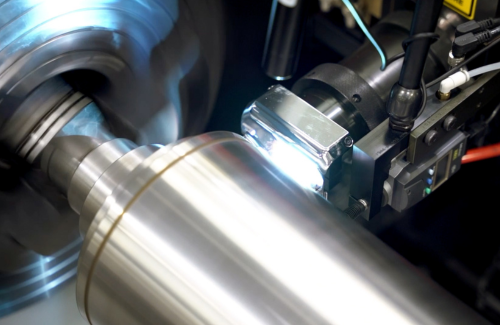
Custom embossing rolls engineered for consistent pattern transfer at production speeds. Mechanical, chemical, and laser engraving available for tissue, film, nonwovens, metal, building materials, and more — built to your substrate, pattern, and production requirements.
Up to 11T
Max Weight
372"
MAX OAL
36"
MAX DIAMETER
3 Methods
MECH / CHEM / LASER
How Embossing Rolls Work
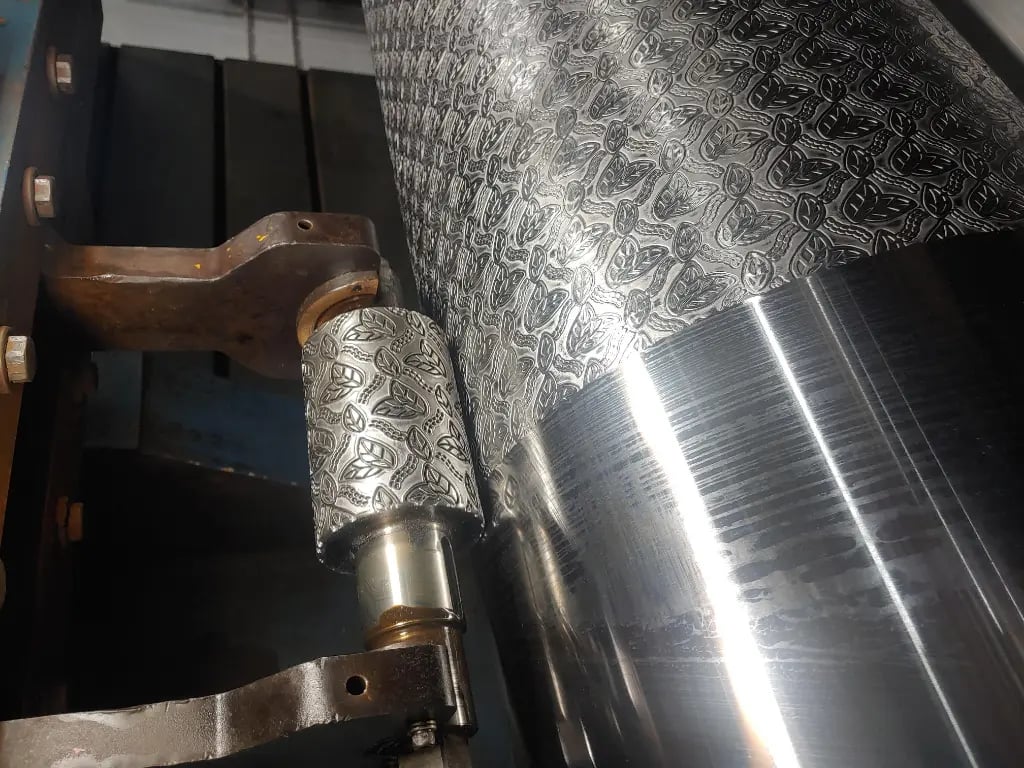
An embossing roll is a precision-engraved cylinder that transfers a raised or recessed pattern into a substrate under controlled pressure and, in many applications, heat. As the substrate passes through a nip formed between the embossing roll and a mating roll — either rubber or a matched steel counter roll — the engraved pattern is pressed into the material surface, permanently altering its texture, structure, or profile.
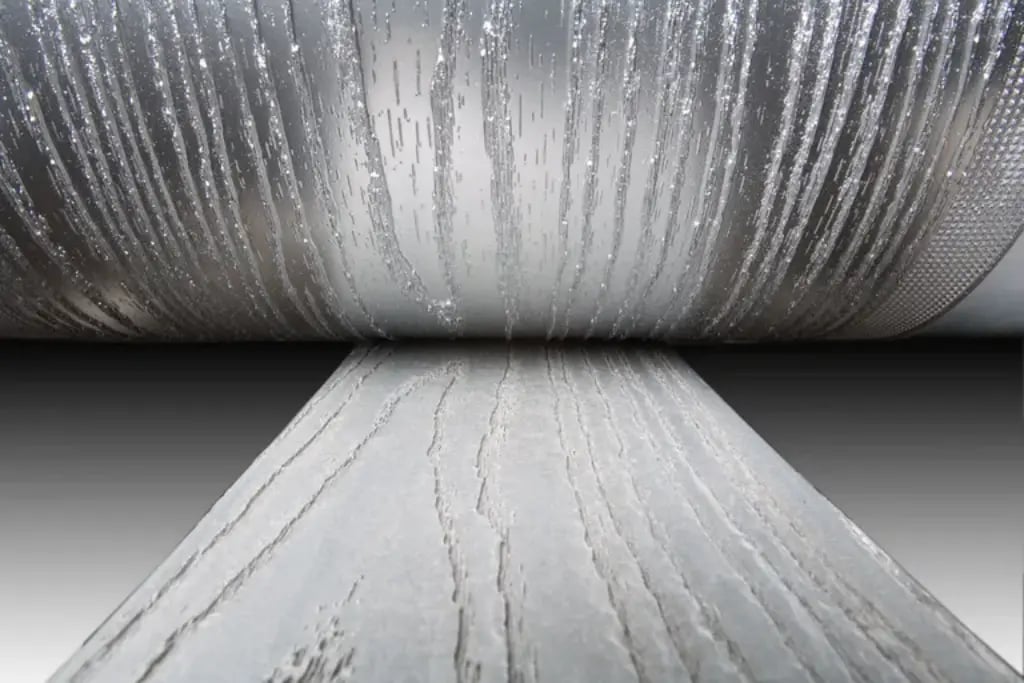
The result can be purely aesthetic — replicating woodgrain, fabric, or geometric decoration — or functionally critical, affecting absorbency, bulk, bond strength, stretch resistance, or surface preparation for downstream lamination and adhesion processes. The precision of the engraving, the roll's dimensional accuracy, and the surface treatment all determine whether the pattern transfers consistently across the full roll width at production speeds.
Two primary nip configurations govern embossing roll selection. Steel-to-rubber configurations use a hard engraved steel roll paired with a conforming rubber counter roll, and are preferred for softer, more compressible substrates — tissue, nonwovens, and lightweight films — where the rubber yields slightly to protect the material while allowing the pattern to emboss cleanly. Matched steel-to-steel configurations use a precision-engraved steel embossing roll and a matched steel anvil roll in registration, producing deep, high-definition pattern transfer on more rigid substrates including foils, heavy films, and industrial materials.
Engraving Method
Pattern Geometry
Depth & Sidewall Angle
Surface Treatment
Roll Configuration
Roll Dimensions
Embossing Roll Applications by Industry
PRS manufactures embossing rolls across a wide range of converting and industrial markets. Each application demands a different combination of engraving method, pattern geometry, depth, and surface treatment — our engineering team works with you to match all variables to your specific substrate and production requirements.
Tissue & Towel
Pattern-engraved rolls that add bulk, absorbency, and tactile structure to bath tissue, paper towel, napkins, and dispenser-compatible formats. Steel-to-rubber nip standard.
Nonwovens
Bond-pattern embossing for hygiene, medical, and filtration substrates. Patterns facilitate fiber bonding, improve tensile strength, and define product structure.
Bag & Can Liners
Micro-pattern embossing improves stretch uniformity and puncture resistance in polyethylene and co-extruded film liners during high-speed converting.
Packaging & Laminates
Pattern embossing for flexible packaging, paperboard, and laminate products — enhancing shelf appeal, surface grip, or adhesive bonding in downstream converting.
Technical Films & Extruded Substrates
Surface modification for lamination adhesion, optical diffusion, release liner preparation, and barrier film processing. Laser engraving preferred for fine geometry.
Metals & Industrial Foil
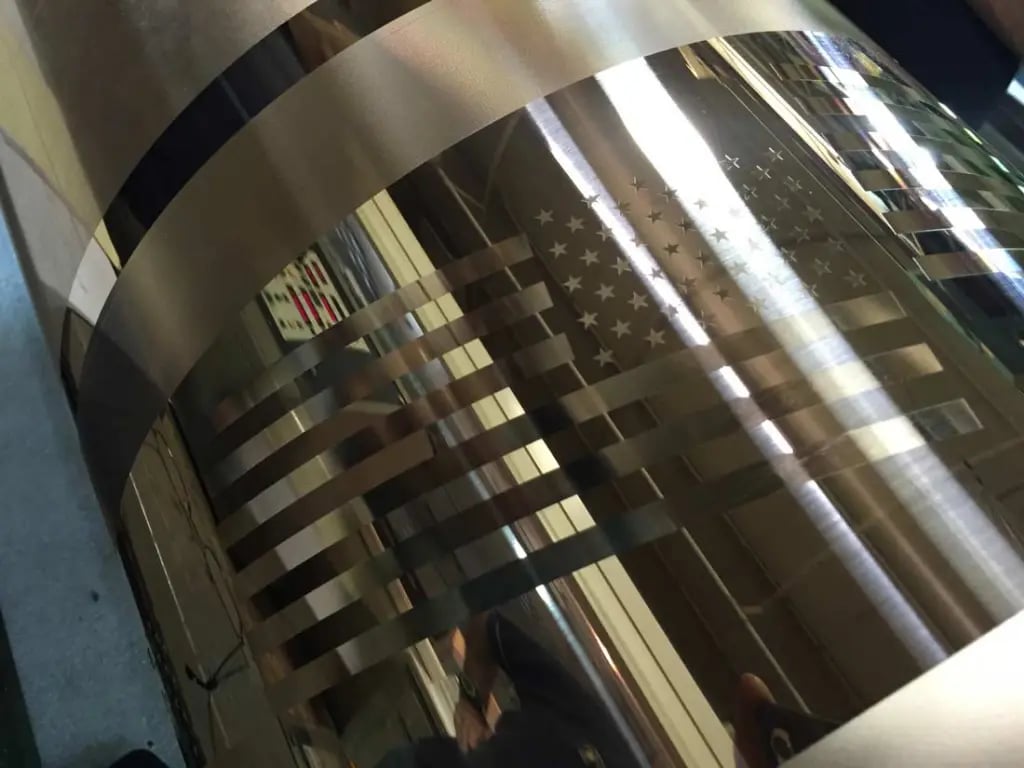
Functional and decorative texturing on steel, aluminum, and foil for structural, anti-slip, or aesthetic purposes. Matched steel-to-steel configuration standard.
Building Materials
Large-format replication of woodgrain, slate, stone, and decorative architectural patterns for vinyl siding, flooring, and cladding substrates.
Automotive
Tactile and visual surface finishing for interior films, door panel substrates, and molded component skins requiring precise texture and pattern consistency.
Custom / Specialty
Don't see your application? PRS has developed embossing solutions for emerging substrates and non-standard converting processes. Contact our engineering team to discuss.
Engraving Method Selection Guide
The engraving method determines pattern sharpness, achievable depth, sidewall geometry, minimum feature size, and long-term cost structure. PRS offers mechanical, chemical, and laser engraving for embossing rolls — the right choice depends on your substrate, pattern complexity, and production volume.
Embossing Roll Specifications
All PRS embossing rolls are fully custom. The following represents our manufacturing envelope — contact us to discuss your specific application requirements.
Embossing Roll Services
Keep your embossing rolls performing at their best with refurbishment, re-engineering, and pattern validation services built for real production demands. Whether you're restoring an existing roll or developing something new, PRS helps you extend roll life, improve output consistency, and confidently validate performance before committing to full-scale production.
Roll Refurbishment & Lifecycle Services
PRS refurbishes PRS-manufactured and customer-supplied embossing rolls, extending service life and restoring performance to original or updated specifications.
- Full roll refurbishment — surface stripping, re-grinding, and re-engraving
- Re-engraving with original pattern artwork or updated designs
- Journal repair and precision balancing to OEM tolerances
- Surface preparation and removal of legacy engraving
- Condition inspection and evaluation to determine refurb vs. replace
- Re-chroming, re-nickeling, or custom re-coating after pattern work
Pattern Development & Pilot Testing
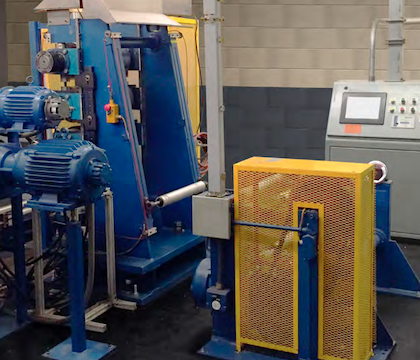
PRS offers in-house pattern development and a pilot converting line for testing embossed substrates before committing to a full production roll — a critical step for novel patterns or new substrate development.
- Custom pattern design from customer artwork, samples, or concepts
- Prototype roll production (rubber-to-steel, up to 12" wide)
- Pilot line embossing trials to validate pattern performance
- Substrate testing across converting speeds and nip pressures
- Pattern refinement and iteration before full-scale commitment
- Documentation and specifications transfer to production roll order
Ready to specify your embossing roll?
Our engineers work directly with you to match pattern geometry, substrate requirements, and production speeds — from first prototype through full production roll delivery.
Resources for Embossing Roll Buyers
Use these resources to support pattern selection, specification development, and application evaluation.
Embossing Pattern Library
Browse PRS's library of available embossing patterns — a starting point for pattern selection or custom development discussions.
Embossing vs. Engraving Guide
Understand the differences between embossing and engraving technologies and when each is the right choice for your converting process.
Full roll lifecycle services
From condition assessment and journal repair through re-engraving and surface treatment restoration.
Validation is key
Validate your embossing pattern and substrate performance on PRS's in-house pilot converting line before committing to a full production roll.
Frequently Asked Questions
Common questions about embossing roll specification, engraving methods, applications, and PRS capabilities.
An industrial embossing roll is a precision-engraved steel cylinder that transfers a pattern into a substrate by pressing the engraved surface against the material under controlled pressure — and in many applications, heat — as it passes through a converting nip. The roll's engraved surface displaces or compresses the substrate material, permanently altering its texture, structure, or profile. Depending on the application, the result may be aesthetic (decorative pattern replication), structural (bulk or bond enhancement), or functional (surface preparation for adhesion, optical modification, or stretch distribution). The mating roll in the nip is either rubber — which conforms to softer substrates — or a precision-matched steel counter roll used when high-definition, deep-relief, or structurally precise patterning is required.
The three engraving methods differ in how the pattern geometry is produced in the roll surface, and each offers distinct performance characteristics. Mechanical engraving uses hardened cutting tools to physically remove material from the roll surface, producing repeating patterns such as dots, lines, and diamonds at high throughput — it is the most cost-effective method for high-volume applications on conforming substrates like tissue and nonwovens. Chemical engraving uses acid-based etching processes to create deeper relief than mechanical methods can typically achieve, and is well suited for large-format architectural or building material patterns requiring significant depth. Laser engraving ablates the roll surface using a focused laser beam, enabling the tightest dimensional tolerances, most complex geometries, and sharpest sidewall definition — it is the preferred method for fine detail work, decorative film applications, and any pattern where cell geometry precision is critical to function or appearance.
The nip configuration is determined primarily by substrate type and the required embossing outcome. A steel-to-rubber configuration pairs the engraved steel embossing roll with a conforming rubber counter roll. The rubber yields slightly to the substrate during the nip, which is advantageous for softer, more compressible materials — tissue, nonwovens, lightweight films — where a hard mating surface would damage or overly compress the material. Steel-to-rubber is the dominant configuration in tissue, hygiene, and flexible packaging embossing. A matched steel-to-steel configuration uses a precision-engraved embossing roll and a corresponding steel anvil or counter roll that is manufactured in registration with the embossing roll. This configuration delivers greater embossing depth, more precise pattern definition, and greater force transmission — it is used for foils, rigid films, metals, and any application requiring deep-relief or structurally precise patterning where a rubber counter roll would not provide sufficient resistance.
PRS embossing rolls have been engineered for a broad range of converting substrates including tissue and paper towel, nonwoven fabrics (spunbond, meltblown, airlaid, and composite structures), polyethylene and polypropylene films, co-extruded and laminated film structures, foil substrates (aluminum and metallic), rigid and semi-rigid technical films, vinyl and PVC (for building and flooring applications), paperboard and specialty papers, and industrial metals. The engraving method, roll configuration, pattern geometry, and surface treatment are all specified in relation to the substrate — there is no universal embossing roll. Contact PRS engineering to evaluate your specific substrate and production conditions.
Embossing roll pattern depth is typically specified in thousandths of an inch (mils) or microns and refers to the distance between the highest point of the roll surface and the lowest point of the engraved pattern geometry. Along with depth, the sidewall angle — the angle at which the engraved walls taper from the surface to the pattern floor — is a critical specification because it controls how easily the substrate releases from the roll after the nip and how sharply the pattern edge appears in the finished substrate. PRS engineers will define both depth and sidewall angle in coordination with the customer's substrate type, nip pressure, speed, and desired embossing result. Pattern prototyping on test rolls up to 12 inches wide allows actual depth and release performance to be validated before committing to a full-width production roll.
PRS applies chrome, nickel, copper, and custom specialty coatings to embossing rolls depending on the application requirements. Hard chrome plating is the most common surface treatment — it provides excellent hardness, wear resistance, and corrosion protection, and is standard for most tissue, film, and industrial embossing applications. Copper is used as an intermediate layer in some engraving processes, providing a soft engraving surface that is then chrome-plated for final use. Nickel plating offers corrosion resistance with moderate hardness and is used in applications where chrome's brittleness or adhesion characteristics are a concern. Custom coatings and specialized surface treatments are available for specific substrate chemistries, temperature requirements, or release performance needs. Surface treatment selection should be discussed with PRS engineering as part of the full roll specification process.
Yes. PRS offers in-house pattern development services for customers who need a pattern created from scratch, replicated from a physical sample or existing roll, or adapted from supplied artwork. The process begins with an engineering evaluation of the pattern requirements — including substrate, converting speed, nip configuration, and desired embossing outcome — followed by pattern design and prototype roll production on test rolls up to 12 inches wide. Pilot line trials using PRS's in-house converting equipment allow the pattern to be tested on actual substrate before the production roll is committed. This development and validation workflow is one of PRS's core differentiators and is particularly valuable for customers introducing new products, changing substrates, or evaluating pattern alternatives without risking a full-scale roll investment.
PRS's manufacturing envelope for embossing rolls includes a maximum weight capacity of up to 11 tons, a maximum overall length of up to 372 inches, and a maximum diameter of up to 36 inches. All rolls are fully custom — there are no standard sizes. Journal dimensions, face length, crown profile, and overall geometry are all specified to the customer's machine requirements. Contact PRS to discuss your specific dimensional requirements and to confirm fit within our manufacturing capabilities for your application.
Refurbishment is appropriate when the roll's core and journal geometry remain within acceptable tolerances and the primary degradation is confined to the engraved surface — worn pattern features, surface finish deterioration, coating damage, or pattern updates required by a product change. PRS refurbishment services include full surface stripping and preparation, re-engraving with original or updated pattern artwork, journal repair and precision balancing, re-coating with chrome, nickel, or custom surface treatments, and final inspection to restored dimensional specifications. Replacement is indicated when core integrity has been compromised, when journal or bore wear exceeds refurbishable limits, or when the economics of refurbishment approach the cost of a new roll. PRS can perform a condition evaluation on customer-supplied rolls to provide a refurb vs. replace recommendation before any work is committed.
Lead times for custom embossing rolls vary depending on roll size, engraving complexity, surface treatment requirements, and current production scheduling. Standard production embossing rolls typically range from several weeks to a few months depending on specifications. Rolls requiring extensive pattern development, prototyping, and pilot line validation will have longer timelines that include development and testing phases prior to production roll commitment. PRS recommends engaging our engineering team as early as possible in the project timeline — particularly for new product development programs or large-format rolls with complex specifications. Contact PRS directly for a lead time estimate specific to your application.
Yes. PRS operates an in-house pilot converting line that allows embossed substrates to be tested at production-representative conditions prior to committing to a full-width production roll order. Pilot line testing validates pattern performance, substrate response, nip pressure and temperature settings, and converting speed behavior — providing the data needed to finalize roll specifications with confidence. This service is particularly valuable for customers developing new products, evaluating pattern alternatives for existing processes, or qualifying a new substrate that has not previously been run through an embossing nip. Pilot testing is offered as part of PRS's pattern development process and can also be engaged independently for customers who have prototype rolls and need a controlled test environment.
Industrial embossing rolls are used across a broad range of converting, manufacturing, and materials processing industries. In the tissue and paper industry, embossing adds bulk, absorbency, and tactile quality to bath tissue, paper towel, facial tissue, and napkins. In nonwovens manufacturing, embossing facilitates fiber bonding and defines the structural and tactile characteristics of hygiene, medical, and filtration products. In flexible packaging and film converting, embossing prepares surfaces for lamination, modifies optical properties, or adds functional texture. In the building materials industry, embossing rolls replicate woodgrain, stone, and architectural surface patterns in vinyl siding, flooring, and cladding. In automotive manufacturing, embossed roll surfaces produce the interior trim textures used in door panels, dashboards, and headliners. In industrial metals and foil processing, embossing delivers functional surface texture for anti-slip, heat transfer, or structural applications. PRS serves all of these markets with custom-engineered rolls built to each application's specific requirements.
Connect with
PRS Experts
Questions? Tough challenge? Need a second opinion on pattern selection, roll specification, or substrate testing? The PRS engineering team is here to guide you from first concept through production roll delivery.