

Anilox Rolls for Flexographic Printing 

Precision Anilox Rolls Built for Consistent Ink Transfer for Modern Flexographic Printing 

Precision Anilox Rolls for Consistent Ink Transfer

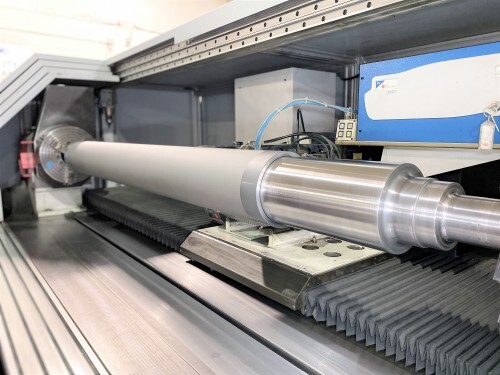
Anilox rolls are the foundation of the flexographic printing process, controlling how much ink or coating is transferred from the ink chamber to the printing plate. Precision-engraved microscopic cells on the surface of the roll meter a consistent volume of ink, ensuring repeatable color density, sharp graphics, and efficient press performance.

At Precision Roll Solutions, we manufacture anilox rolls designed to deliver consistent ink transfer, optimized cell geometry, and long service life across demanding printing environments. From flexible packaging and labels to corrugated and industrial coating applications, our rolls are engineered to meet the exact requirements of your press and substrate.

anilox roller hero

Why Anilox Roll Design Matters

The performance of an anilox roll depends on several key variables that influence ink transfer and print quality:

  • Cell Geometry – Hexagonal, elongated, or channel engravings designed for specific ink transfer behavior
  • Line Screen (LPI) – Determines print detail and resolution
  • Cell Volume (BCM) – Controls the amount of ink delivered to the plate
  • Surface Coatings – Ceramic and other materials improve durability and wear resistance
  • Precision Manufacturing – Tight tolerances ensure consistent results across the roll width

The right combination of these factors allows printers to achieve accurate color reproduction, reduced waste, and improved press efficiency.

Common Applications for Anilox Rolls

Precision Roll Solutions manufactures anilox rolls for a wide range of industries including:

  • Flexographic printing
  • Corrugated packaging
  • Labels and narrow web printing
  • Flexible packaging
  • Coating and laminating applications

Our engineering team works closely with customers to determine the ideal engraving pattern, volume, and roll construction for each application.

Anilox & Precision Rolls

For 42 years, ARC has been a leading supplier of anilox and precision rolls to the flexographic and corrugated industries.  Precision Roll Solutions manufactures and services a range of precision rolls designed for durability and consistent performance in demanding production environments. Together, this is the only team in the industry that can deliver specialized narrow- and wide-web rolls to your exact specifications.

Cell Geometry Capabilities 

Cell geometry is one of the most important variables in anilox roll performance. While line count and cell volume determine how much ink a roll can carry, the shape and structure of the engraved cell control how ink fills, releases, wipes, and cleans during printing.

Two anilox rolls with the same volume can perform very differently depending on cell geometry. The right geometry improves ink release efficiency, doctor blade interaction, ink circulation, and cleaning performance, ultimately affecting print quality and press efficiency.

ARC International engineers four proprietary cell geometries designed to support different flexographic printing requirements — from heavy ink laydown to high-resolution graphics.

Laser roller
OC

OC™ Opticell™

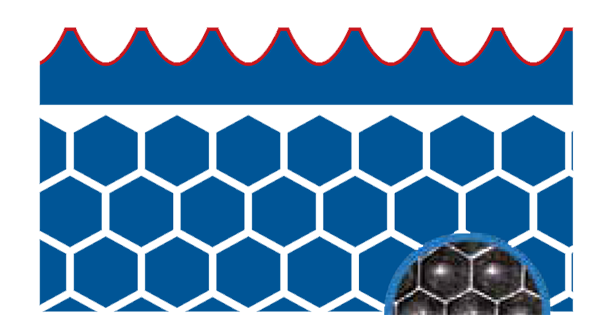
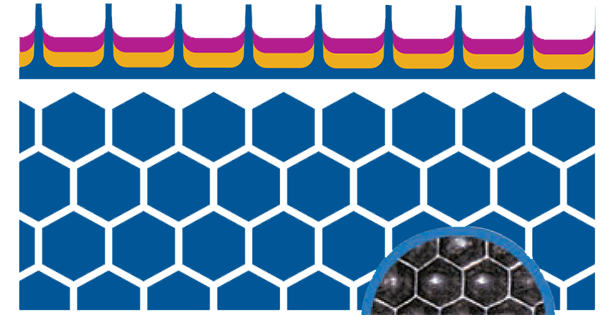
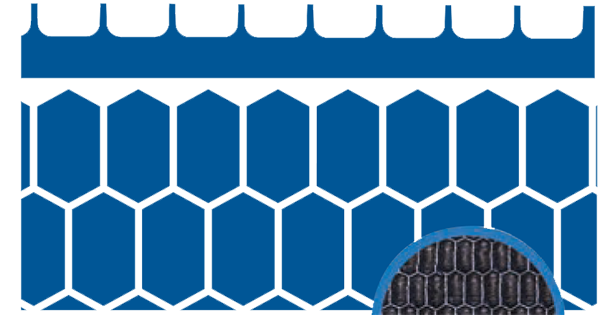
OC™ is ARC’s highest-capacity anilox cell geometry, designed for maximum ink transfer and heavy coverage applications. The 60° hexagonal pattern creates deep cells with high packing density, allowing the roll to carry and deliver large volumes of ink or coatings

OC™ is commonly used for solid flood coats, white ink laydown, corrugated printing, and heavy adhesive or coating applications where maximizing ink volume is the primary objective.
HV

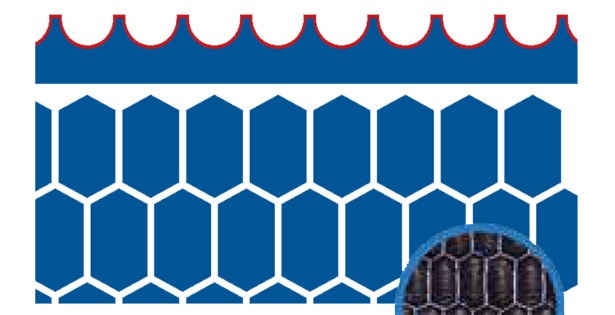
HV™ High Volume

HV™ geometry balances high ink volume with improved doctor blade support and ink circulation. The 70° cell angle and rounded “U” shaped bottom create a wider opening that allows ink to circulate more freely and reduces friction between the blade and roll surface.

This geometry is well suited for high-speed production environments, combination print jobs, and applications where blade wear or cell plugging are common concerns.
HG-1

HG™ High Graphic

HG™ cell geometry is designed for high-resolution flexographic printing and fine graphic detail. These cells are produced using multi-hit laser engraving to achieve consistent cell structure at very high line count

HG™ excels in process color printing, small text, fine line work, and detailed packaging graphics where thin, controlled ink films are required for accurate reproduction.
HD-2

HD™ High Definition

HD™ represents ARC’s most advanced cell geometry, using layered 3-D laser engraving to create hybrid cell structures that optimize ink release and print clarity.

This geometry is designed for premium flexographic printing applications, including high-end packaging and jobs where flexo is competing with offset or gravure print quality.

Selection Guide: Matching Geometry to Application

Your Primary Need comptab-infoalt7-icon
Geometry
Why
Maximum ink volume — solids, floods, white
OC OptiCell
Deepest cells, highest BCM capacity at low-to-mid line counts
High-speed production, blade wear reduction
HV High Volume
70° angle improves blade support; better inkcirculation reduces plugging
Fine graphics, process color, detail
HG High Graphic
Multi-hit laser engraving for clean halftonesat high line counts
Premium quality —competing with offset / gravure
HD High Definition
3-D layered laser for optimized ink release at finest achievable detail
Combination — solids + graphics on same press
HV or OC (solid deck) + HG (graphics decks)
Different geometries on different decks,matched to each deck's function
Coating, laminating, adhesive application
Application-specific — consult PRS/ARC
Fluid viscosity, transfer volume, and substrate determine geometry. Mechanical engraving may also apply.

Doctor Blade & Chamber Systems 

Doctor blade systems are essential to flexographic printing, controlling how ink is wiped from the anilox roll and ensuring a consistent ink film for transfer to the printing plate. Proper blade selection and system setup help maintain clean wiping, reduce ink waste, and improve print consistency across the press.

Precision Roll Solutions supports a range of doctor blade technologies designed to work with modern anilox rolls and high-speed flexographic printing environments.


chamber
Dotscope-1

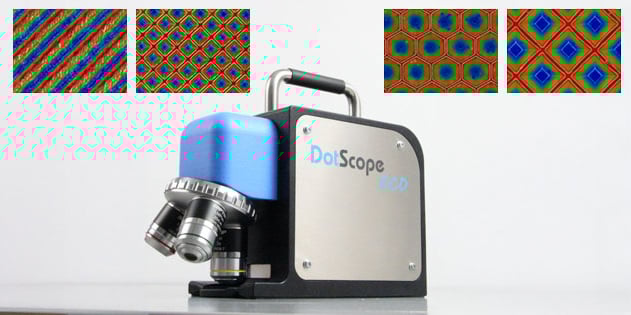
DotScope®

DotScope® is ARC International’s digital inspection technology for evaluating anilox cell condition and performance. Using high-resolution imaging, DotScope allows operators to measure cell volume and identify issues such as plugging, wear, or damage that can impact ink transfer and print quality.

Routine inspection helps maintain consistent printing results and extends the life of anilox rolls.

The Complete Guide to Anilox Rolls

Learn everything you need to know about anilox rolls—from how they control ink transfer and print quality to the key specifications that impact flexographic printing performance.

anilox roller
3-anilox-rolls

Anilox Roll Cleaning

Discover why proper anilox roll cleaning is essential for maintaining ink transfer, print quality, and extending the life of your flexographic printing equipment.

FAQs

1. What is an anilox roll and what does it do?

An anilox roll is a precision-engraved metering roll used in flexographic printing to transfer a controlled, repeatable volume of ink from the ink chamber to the printing plate. The roll's surface is covered with microscopic engraved cells, measured in billions of cubic microns (BCM) that fill with ink, are wiped clean by the doctor blade, and release a consistent ink film to the plate with each revolution. The precision of the anilox roll is the primary factor controlling ink density, color consistency, and overall print quality.

2. What is the difference between an anilox roll and an anilox sleeve?

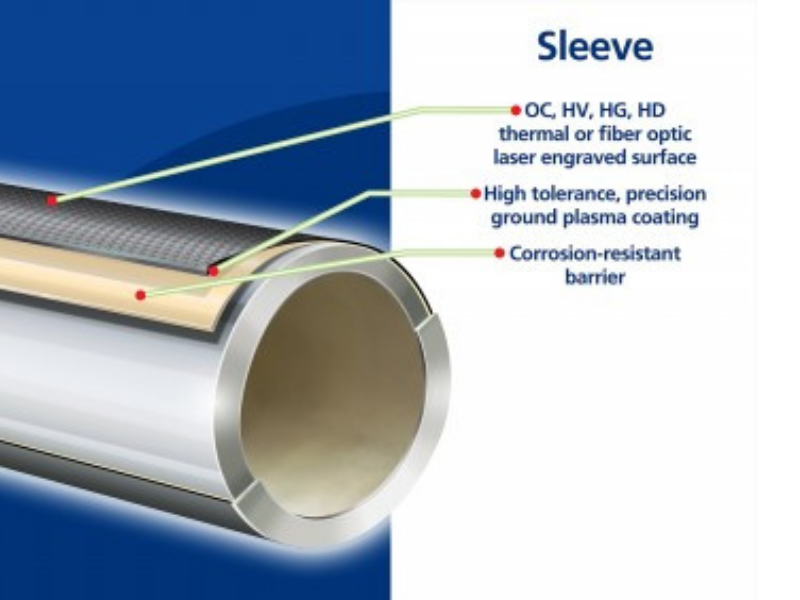
 Both perform the same ink metering function, but the format is different. A conventional anilox roll is a solid, self-contained roll with its own steel or aluminum core. An anilox sleeve is a thin-walled cylinder designed to mount over a lightweight air mandrel, allowing it to be slid on and off the press rapidly. Sleeves are preferred in modern flexographic presses where minimizing changeover time is operationally critical. ARC International manufactures both formats to the same engraving and coating specifications. 

3. What does BCM mean on an anilox roll specification?

BCM stands for Billion Cubic Microns — the standard unit of measurement for anilox cell volume. It describes the total ink-carrying capacity of the roll's engraved surface per square inch. A higher BCM indicates a greater volume of ink delivered per impression, which is appropriate for solid flood coats, white ink laydown, or heavy corrugated printing. Lower BCM values support fine graphic work and process color printing where a thin, controlled ink film is required. BCM must be matched to the ink, substrate, and printing application to achieve optimal results.

4. What are the most important variables when selecting an anilox roll?

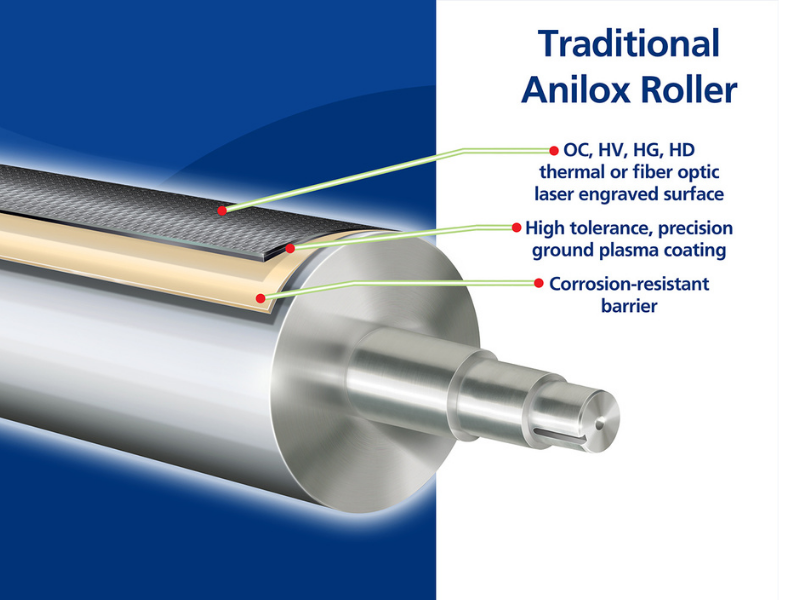
Five variables govern anilox roll selection: line count (LPI), cell volume (BCM), cell geometry, surface coating, and roll construction. Line count and BCM define how much ink the roll carries; cell geometry controls how ink fills, releases, and cleans; the surface coating (typically ceramic applied via plasma spray) determines wear resistance and service life; and roll construction — including core material, balance, and TIR (Total Indicator Runout) tolerances — ensures consistent performance across the press width. ARC International's engineering team evaluates all five variables in combination when specifying rolls for a customer's press and application.

5. What cell geometry options does ARC International / Precision Roll Solutions offer?

 ARC/PRS engineers four proprietary cell geometries, each designed for a distinct printing requirement. OC™ Opticell™ is the highest-capacity geometry, utilizing a 60° hexagonal pattern for maximum BCM and coverage applications such as flood coats and corrugated printing. HV™ High Volume uses a 70° cell angle with a rounded U-shaped bottom to balance high volume with improved doctor blade support and reduced cell plugging at speed. HG™ High Graphic employs multi-hit laser engraving to produce consistent, clean cells at high line counts for process color and fine detail work. HD™ High Definition uses layered 3-D laser engraving to create hybrid cell structures engineered for premium flexographic applications where print quality must compete with offset or gravure. Selecting the right geometry — not just the right volume — is one of the most consequential decisions in press optimization. 

6. How does cell geometry affect doctor blade performance and blade wear?

 Cell geometry directly influences the contact dynamics between the doctor blade and the roll surface. Geometries with steep cell walls and tight opening angles — such as those optimized for maximum volume — create higher friction at the blade tip and can accelerate wear. HV™ geometry was specifically developed to address this: its wider cell opening and rounded cell bottom allow ink to circulate more freely and reduce the shear force on the blade, extending blade life and reducing ink foaming at high press speeds. Matching geometry to blade type and press speed is essential to achieving consistent wiping without premature blade or roll surface degradation. 

7. What is the ARCJET™ coating and why does it matter?

ARCJET™ is ARC International's proprietary ceramic coating process applied to the anilox roll surface prior to laser engraving. The coating is plasma-sprayed to create a high-density, precision-ground ceramic layer that provides the hardness and dimensional stability required for accurate laser ablation of cell structures. A higher-quality coating produces cleaner, more consistent cell walls, which translates directly to more accurate and repeatable ink metering. ARCJET™ coating is standard across ARC's anilox roll product line and is a key factor in the long service life of ARC rolls.


8. How should anilox rolls be cleaned, and does cleaning method vary by ink type?

Yes — cleaning method must be matched to the ink chemistry. Water-based ink systems generally respond well to enzymatic or alkaline aqueous cleaners applied via ultrasonic bath or on-press wash systems. UV-cured inks require chemistry specifically formulated to break down photoinitiated-crosslinked residue, which standard aqueous cleaners cannot effectively dissolve. Solvent-based systems typically clean more readily but require appropriate ventilation and waste handling. In all cases, mechanical cleaning methods such as abrasive media blasting should only be performed by qualified service providers, as improper technique can damage cell walls and ceramic coating. ARC/PRS recommends reviewing cleaning protocols when switching ink chemistry or when DotScope® inspection reveals progressive plugging not responding to standard on-press cleaning.


9. How do I know when an anilox roll needs to be replaced or re-engraved?

 The primary indicators of anilox roll degradation are measurable: declining ink density at a given press setting, increasing makeready time to achieve color targets, visible cell plugging under magnification, or a measured reduction in cell volume via a DotScope® or equivalent inspection instrument. Because cell volume loss is gradual, many printers do not identify the problem until it has significantly impacted press efficiency and ink consumption. ARC recommends establishing a routine inspection protocol — measuring BCM at defined intervals — so that roll condition is tracked objectively rather than assessed by subjective print observation alone. 

10. What is DotScope® and how is it used in anilox roll management?

DotScope® is ARC International's digital anilox cell inspection system. Using high-resolution optical imaging, DotScope® captures and analyzes cell structure to measure actual cell volume (BCM), identify plugging patterns, and detect surface wear or damage. The system allows press operators and pressroom managers to make data-driven decisions about cleaning protocols, roll rotation, and re-engraving schedules — replacing the guesswork that has historically driven anilox management. Routine DotScope® inspection also supports warranty documentation and provides a baseline record when new rolls are placed into service. 

11. What causes anilox cell plugging and how can it be prevented?

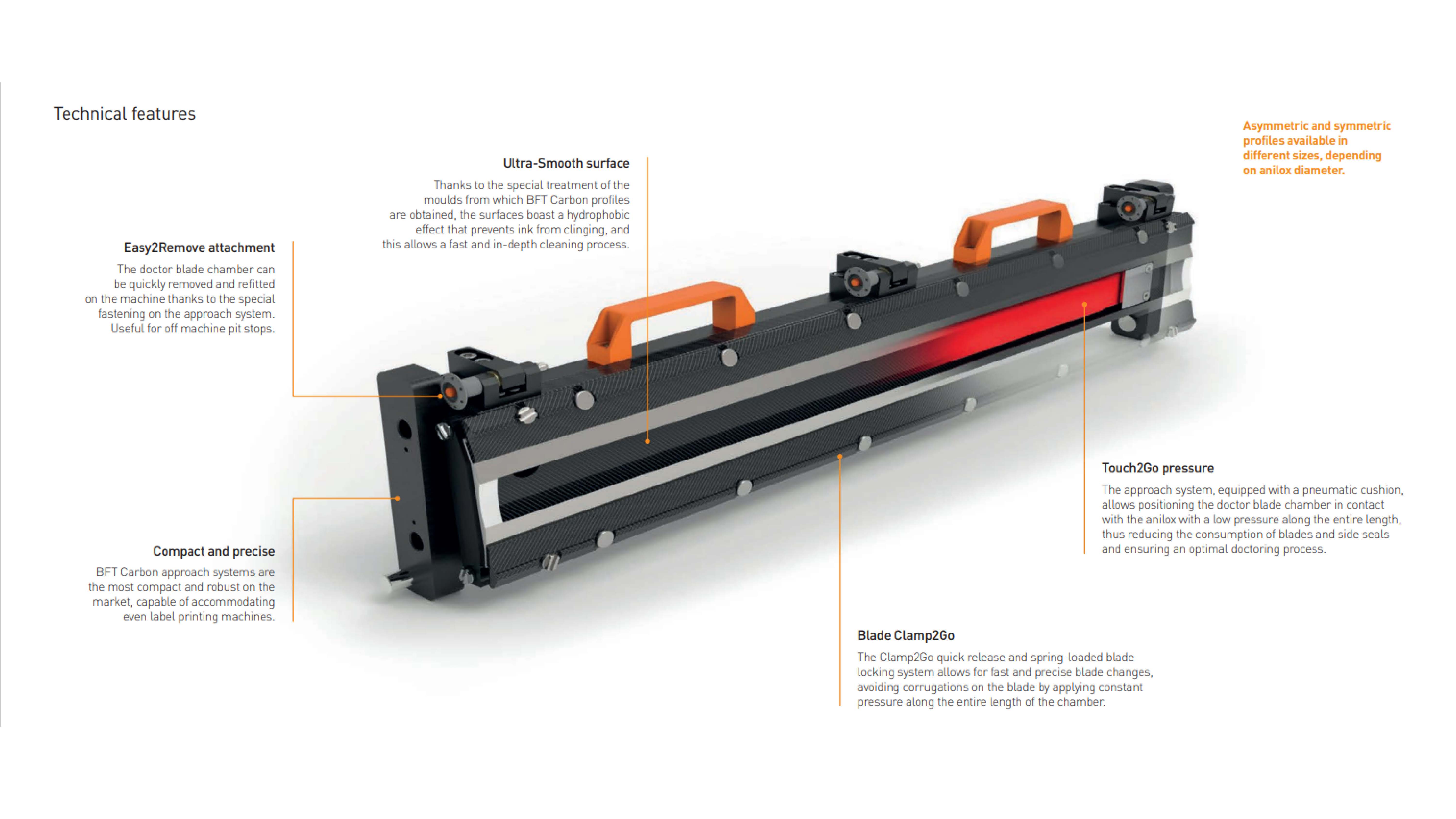
Cell plugging occurs when dried or polymerized ink, coating residue, or particulate contamination accumulates within the engraved cells, reducing their effective volume and disrupting consistent ink transfer. The primary causes are insufficient end-of-run cleaning, ink chemistry incompatibility, and running cell volumes that are too small for the ink viscosity in use. Prevention involves a disciplined cleaning protocol matched to the ink system — water-based, UV, or solvent — combined with periodic deep cleaning using chemistry appropriate to the contamination type. BFT Carbon fiber chamber systems, with their smooth internal surfaces and full-length blade contact, reduce contamination accumulation during production and simplify end-of-run cleaning.


12. What are BFT Carbon fiber ink chamber systems and what advantages do they offer?

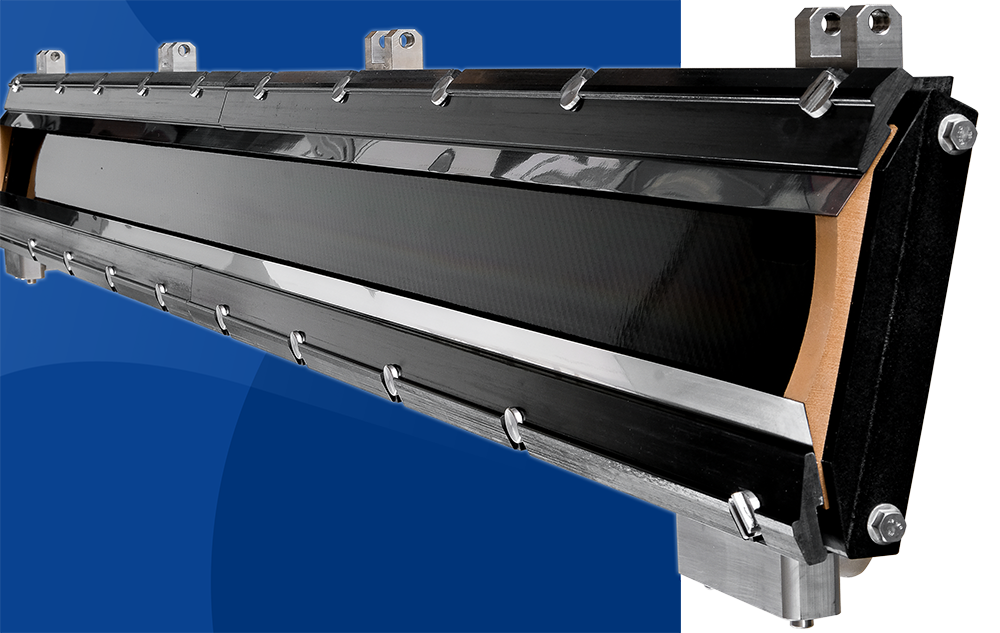
BFT Carbon fiber chamber systems are precision-engineered enclosed doctor blade chambers manufactured from carbon fiber composite. Compared to traditional aluminum chambers, carbon fiber construction provides a superior stiffness-to-weight ratio, which translates to more consistent blade pressure across the full length of the anilox roll — a critical factor in achieving uniform ink wiping and reducing streaking on wide-web presses. BFT Carbon chambers feature an ultra-smooth internal surface that resists ink adhesion and simplifies cleaning, reducing both ink waste and downtime. PRS/ARC offers the BFT Carbon line including Touch2Go, Clamp2Go, and Easy2Remove configurations, as well as BFT Flexo digital integration for real-time press monitoring.

13. What is the difference between thermal and fiber optic laser engraving?

 Both are laser engraving technologies used to ablate cells into the ceramic surface of an anilox roll, but they operate differently. Thermal laser engraving uses a CO₂ or Nd:YAG laser to vaporize ceramic material through heat. Fiber optic (fiber) laser systems deliver energy via fiber optic cable and offer greater precision and consistency at high line counts, with tighter control over cell depth and wall geometry. ARC International operates both thermal and fiber optic laser platforms, which allows the engineering team to match the engraving method to the geometry specification and application — particularly relevant for HG™ and HD™ geometries requiring multi-hit or layered engraving. 

14. What corrugated roll types does PRS/ARC manufacture beyond anilox rolls?

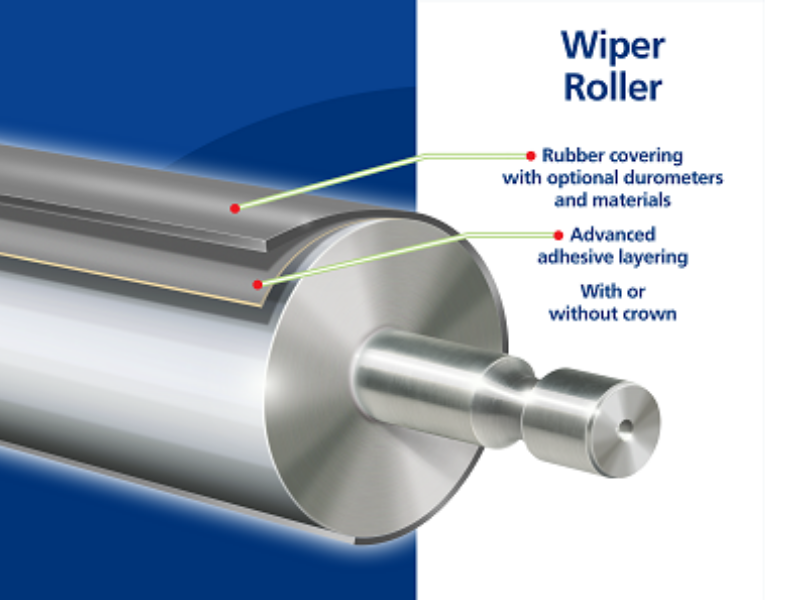
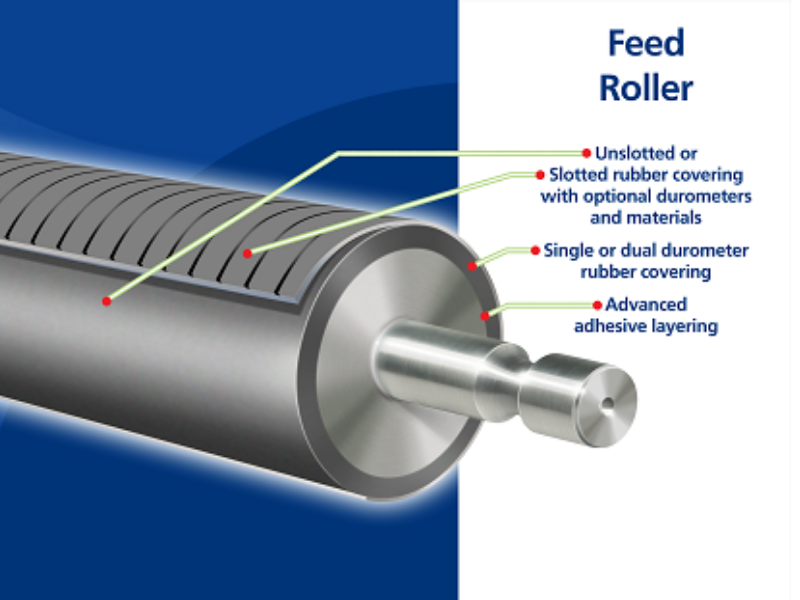
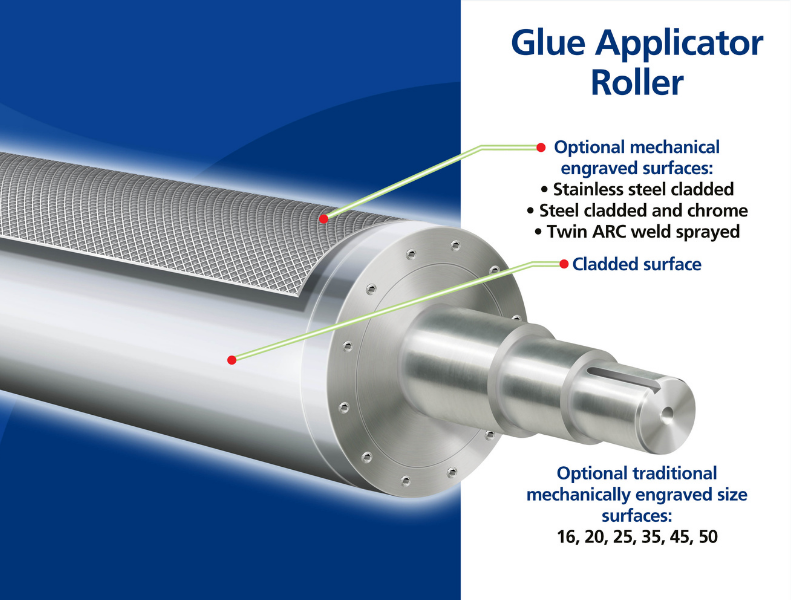
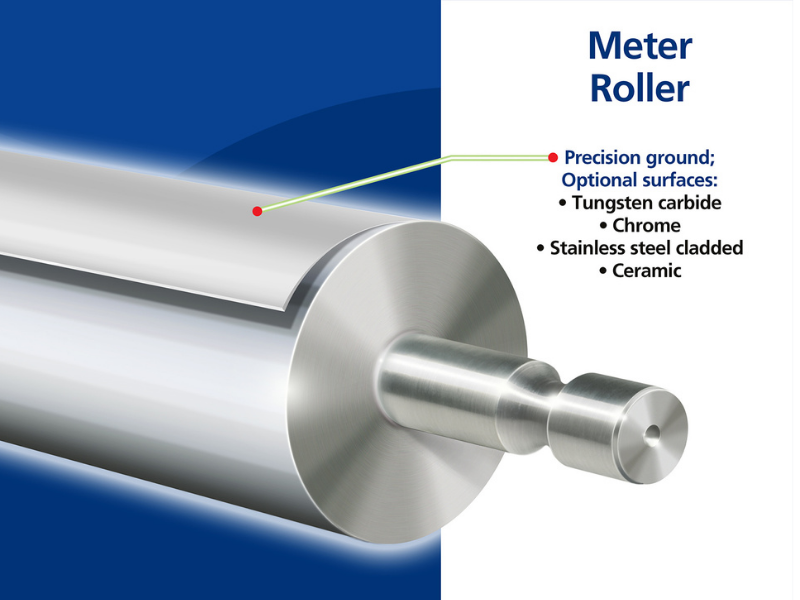
For corrugated post-print flexographic applications, PRS/ARC manufactures glue applicator rolls for corrugated board production and converting, rubber wiper rolls for ink distribution and metering control, rubber feed rolls for sheet feeding with proper alignment and traction, and meter rollers for coating, adhesive, and liquid application systems. Each of these rolls is manufactured to press-specific dimensional tolerances and material specifications — rubber durometer, surface finish, crown profile, and TIR — to ensure compatibility with the anilox system and the press OEM's requirements. 

Back to top

Connect with
PRS Experts

Questions? Tough challenge? Need a second opinion? The PRS experts are here to guide you to your next-level engraved or precision roll solution. Set up a consultation today!


Request A Consultation